Improving User Experience: A Guide to Custom Membrane Keypad Embossing
When designing an interface for your product, the way it feels under a user’s fingertip is just as important as how it looks. At RH Technical Industries, we know that the difference between a good product and a great one often comes down to tactile feedback. If you are looking to enhance the functionality and professional finish of your interface, understanding your custom membrane keypad embossing options is the best place to start. Embossing doesn’t just add a 3D effect; it guides the user, reduces input errors, and gives your product a high-quality, responsive feel.
Precision Engineering: How Embossing is Made
Embossing has been around since ancient Egypt, Greece, and Rome, where people used it to create raised designs on metal (coins), leather and paper. Today, creating a durable, tactile surface requires more than just a simple press. To achieve high-quality custom membrane keypad embossing, we use a specialised process involving precision-machined “male” and “female” dies. The graphic overlay material—typically a high-performance polyester or polycarbonate—is placed between these two metal tools.
Under strict heat and pressure, the tool permanently reshapes the material to match its profile. It’s a delicate science; we have to account for the “stretch” of the plastic to ensure your printed graphics don’t distort and the material doesn’t become brittle. This careful calibration is what ensures the buttons stay crisp and responsive, even after years of heavy industrial use.

Why Does Embossing Matter?
In an era of flat touchscreens, physical buttons provide a sense of certainty. When a user presses a button on a medical device or an industrial controller, they need to know—without looking—that their finger is in the right place. Embossing creates the physical boundaries that make this possible.
Exploring Your Embossing Options
There is no “one size fits all” approach to interface design. The best embossing style depends on your industry and how you use the device; each offers unique benefits.
Rim Embossing (Perimeter or Fret)
Rim embossing creates a raised border around the edge of the key. This is a popular choice because it leaves the centre of the button flat, making it easy to print clear icons or text. It provides a distinct tactile “landing zone” for the user’s finger, ensuring they hit the centre of the switch every time.
Plateau and Pillow Embossing
If you want the entire button area to be raised, plateau (often called pillow) embossing is the ideal solution. The switch area is pressed upward into a flat-topped mound. This gives the keypad a modern, professional aesthetic and makes the buttons very easy to locate in low-light environments.
Dome Embossing
Dome embossing creates a rounded, circular profile. This style is often used when a very crisp, “snappy” tactile response is required. Manufacturers frequently pair it with metal domes under the graphic overlay to provide the satisfying click users associate with high-end machinery.
De-bossing
While embossing raises the surface, de-bossing creates a recessed area. This is an excellent choice for “reset” buttons or critical functions that you do not want the user to press accidentally. By placing the button in a groove, you add a layer of safety to the operation.
Braille and Accessibility
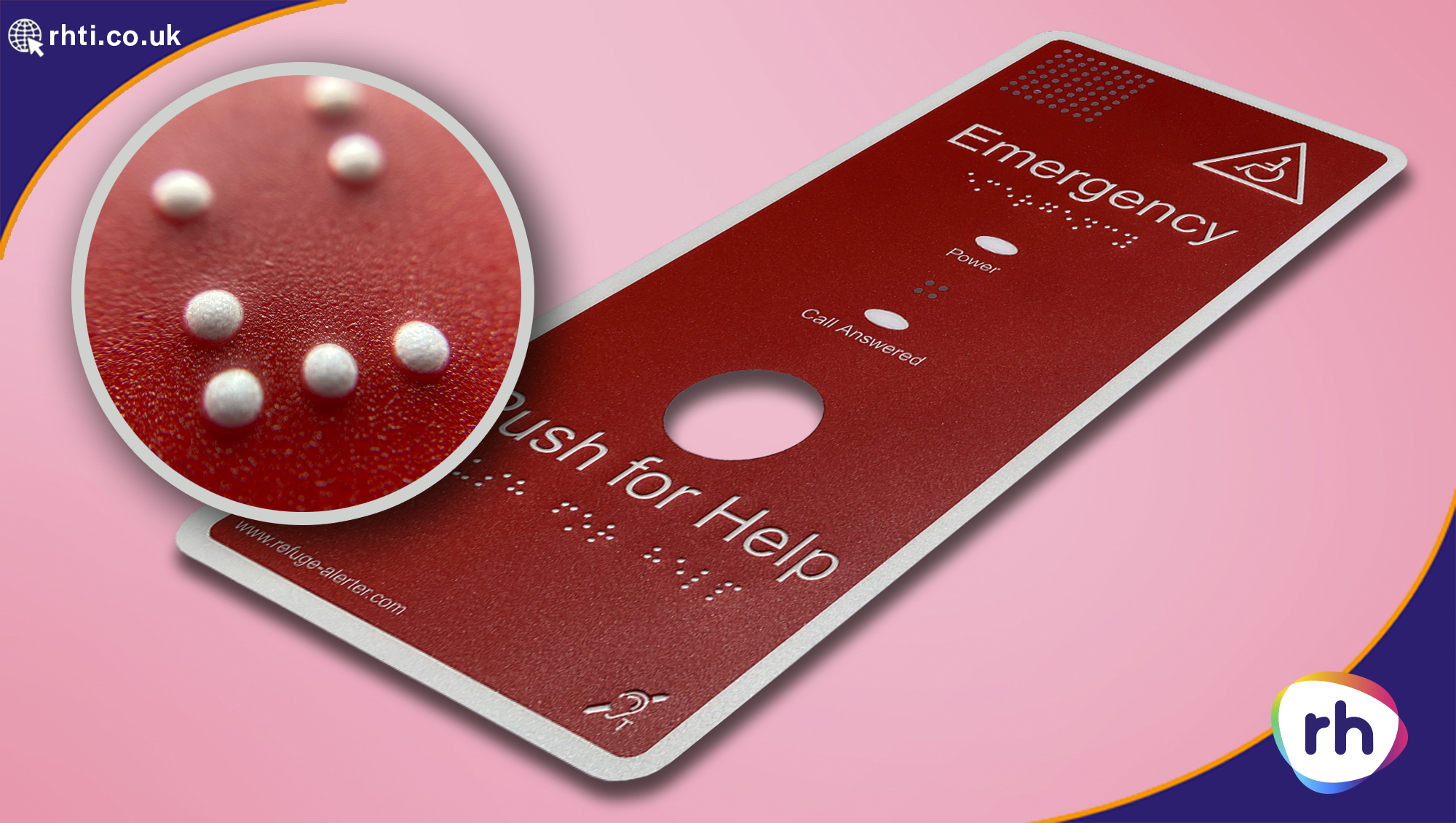
Custom membrane keypad embossing is also a vital tool for inclusivity. We can incorporate Braille characters directly into the graphic overlay. Because our embossing process is precise and durable, these tactile dots remain sharp and readable throughout the product’s lifespan.
Taking It Further: LED Backlighting
Embossing works hand-in-hand with illumination. By using “secret-until-lit” graphics or integrated LEDs, we can highlight the embossed areas. This is particularly effective for “Fret” embossing, where the light can follow the perimeter of the key, or for Plateau embossing, where the entire raised surface glows.
Integrating LED backlighting ensures your interface remains functional in dark environments while adding a “wow” factor that sets your product apart from the competition.
Why Choose RH Technical Industries?
While many manufacturers offer basic overlays, RH Technical Industries focuses on the technical precision required for long-term durability. We don’t just print graphics; we engineer interfaces. Our team works with you to choose the right height, shape, and material tension to ensure your keypad survives millions of actuations without losing its shape.
If you are currently comparing options from other suppliers, we invite you to feel the difference for yourself. Our bespoke approach to custom membrane keypad embossing ensures that your product isn’t just another piece of hardware—it’s a premium user experience.

Ready to elevate your interface design? Contact our engineering team today at www.rhti.co.uk to discuss your project requirements or request a sample pack.