
Engineering the Graphic Overlay for the PhotonUVC Vet
The Summary:
When Photon Therapeutics developed the PhotonUVC Vet, they were creating a world-first treatment for animal corneal infections. To bring this medical innovation to life, they needed a new user interface. It had to balance aesthetic appeal with the demands of high-stakes veterinary performance.
By collaborating with RH Technical Industries, Photon Therapeutics secured a custom graphic overlay that met rigorous specifications: textured surfaces for clinical durability, grey diffused windows for light balance, and sub-surface digital printing for long-term clarity. This case study explores how RH’s precision manufacturing supported a breakthrough in animal eye therapy.
The Medical Challenge: A New Frontier in Eye Hygiene
In veterinary medicine, eye infections—specifically corneal keratitis—are a leading cause of pain and blindness. These infections can be bacterial, fungal, or viral, and they often progress rapidly. Traditionally, veterinarians have relied on antibiotic drops that require frequent application, a treatment approach that not only demands consistent compliance but also contributes to the growing challenge of antimicrobial resistance.
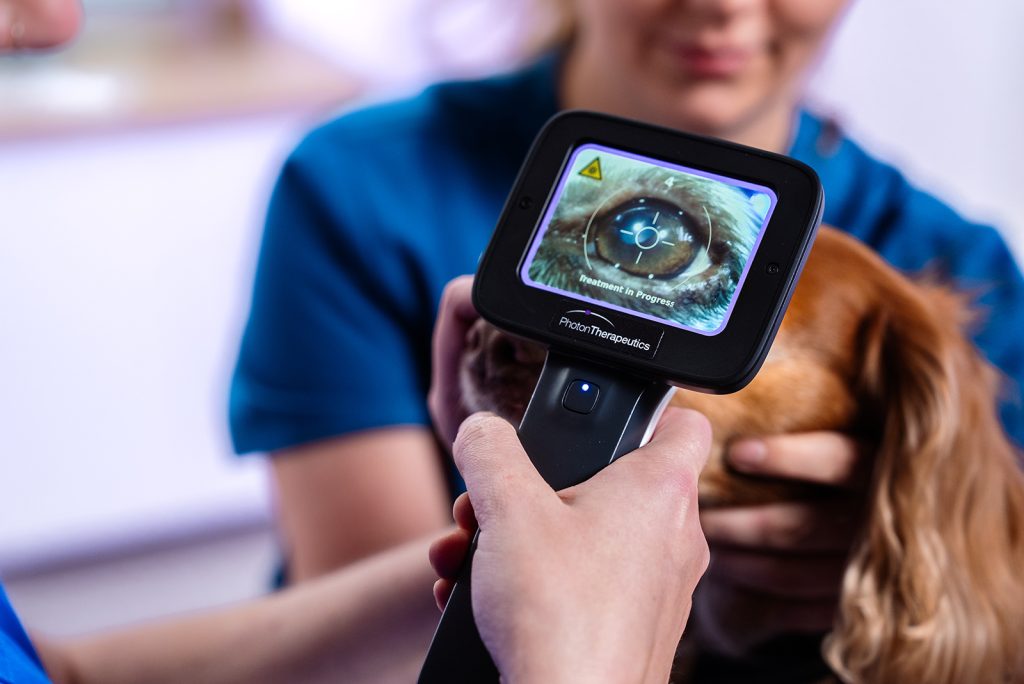
The PhotonUVC Vet offers a non-contact alternative. Using patented UVC light technology, the device deactivates the DNA of infecting microbes in just five seconds. However, to treat a sensitive area like the eye, a veterinarian needs more than just a light source; they need a high-precision diagnostic and delivery tool.
The device features a dual-lighting system to assist in this process:
- White Light: Used for general illumination to visualise the eye’s surface and check for debris or clouding.
- Blue Light: Used in conjunction with fluorescein dye to highlight corneal ulcers and abrasions, making them glow for easy identification.
The challenge for RH was to create an interface that allowed these lights to perform their diagnostic roles. At the same time, they had to ensure the overall device remained sterile, durable, and intuitive.
https://photon-therapeutics.com/
Testimonial:
“Working with RH Technical Industries on the PhotonUVC Vet interface was a genuinely collaborative and efficient process. They quickly understood the functional constraints of a veterinary medical device and translated those into a high-quality graphic overlay that met both performance and manufacturing requirements.
Turnaround times were excellent, and RH were highly responsive to design iterations as the device matured. As we progressed towards production, they proactively supported refinements such as improved adhesive layout and the addition of a practical pull tab for easier liner removal during assembly—small details that made a meaningful difference on the manufacturing line.
The final component delivered precise optical performance for the illumination windows, robust clinical durability, and consistent dimensional accuracy, all of which were critical for a sealed, hygienic handheld device.
RH Technical Industries were flexible, technically engaged, and easy to work with throughout. I would be confident recommending them for medical device graphic overlays or other applications where tight tolerances, material performance, and production usability are essential.” – Senior Design Engineer | Medical Devices
Beyond the “Dead-Front”
Many consumer electronics use dead-fronting—a technique in which the display is completely black until it is illuminated by LED Backlighting. However, for a veterinary device such as the PhotonUVC Vet, this wasn’t the right approach.
The device’s LED windows needed to be visible even when inactive, acting as a guide for the user while remaining aesthetically integrated. More importantly, these windows had to be balanced If the material was too thick or the tint too dark, the diagnostic light wouldn’t reach the eye. If it were too clear, the internal components would be exposed, which would look unprofessional and could allow light leakage.
The RH Solution: Materials and Manufacturing
RH’s approach focused on three pillars of engineering: light management, material durability, and cutting precision.
The Surface: Clinical-Grade Texture
RH selected a high-performance textured polyester for the overlay. In a veterinary clinic, surfaces are constantly wiped down with harsh disinfectants. A textured finish prevents any possibility of showing unsightly fingerprints. The RH textured surface provides:
- Glare Reduction: Critical for veterinarians working under bright surgery lights.
- Chemical Resistance: Preventing the material from degrading when exposed to cleaning alcohols.
- Tactile touch: Ensuring the handheld device feels right to the touch, even when wearing surgical gloves.
The Windows: Grey Diffusion for Balanced Emission
Instead of a standard clear or blacked-out window, RH utilised a digital grey filter colour with no white backup. These windows are not meant to disappear; rather, there is no unwanted contrast between the filter’s chosen colour and the black background; the filter remains subtle and functional.
Crucially, RH’s engineering team had to calibrate the diffusion to ensure emission balance. The window acts as a filter, allowing the blue and white diagnostic lights to pass through with the exact right intensity. This ensures the veterinarian gets a clear view of the corneal ulcer without the light being so bright that it causes flare on the device’s camera, prompting the animal to squint, or so dim that it misses the infection.
The Print: Strategic Cost-Effectiveness
To provide the most cost-effective solution for the project, RH used digital printing to achieve the solid colours and clear iconography required for a professional medical look. While screen printing remains the gold standard for the absolute sharpest print quality, digital printing offers a high-performance balance for this specific application. By printing on the sub-surface (the back of the clear material), the graphics are physically shielded from the outside world. This ensures the print can never be scratched off or faded by clinical cleaning agents, keeping the device legible and professional throughout its entire service life.
The Bond: 3M Industrial Adhesive
Any medical device used on animals or humans must maintain a sealed system to ensure clinical hygiene. To prevent moisture, hair, or dander from gathering in the device recesses, RH used a high-tack 3M adhesive to back the overlay. This adhesive was digitally cut to perfectly match the device’s complex footprint. The result is a flush, integrated seal that holds firm, even during heat fluctuations from the UVC LEDs. Because of this precision, the interface remains a permanent and sanitary part of the tool’s ergonomic body. There is no risk of the edges lifting or trapping unwanted debris.
The Cut: Small Scale, High Stakes
Compact and handheld, the PhotonUVC Vet offers extremely limited space for the graphic overlay. This required RH to perform high-precision digital cutting. In larger industrial applications, a deviation of 0.5mm might go unnoticed. On the PhotonUVC Vet, such a gap would act as a dirt trap or cause the LED windows to misalign with the internal diagnostic lights. RH used a camera-guided cutting system to ensure the overlay was cut to a precise linear tolerance of ±0.25mm. This accuracy ensures the overlay sits perfectly flush within the device’s housing, contributing to the premium veterinary tool look that Photon Therapeutics desired.
Impact on Animal Welfare
The result of this partnership is a tool that is changing the standard of care in veterinary ophthalmology. Because the RH interface is so reliable and easy to clean, veterinarians can move quickly between patients.
- Speed: Treatments take only five seconds, reducing stress for the animal.
- Hygiene: The non-contact nature, supported by the sealed RH overlay, eliminates the risk of cross-contamination between eyes or patients.
- Accuracy: The balanced light emission through the grey windows enables precise detection of ulcers using the blue/fluorescein method.
Conclusion: A Partnership Built on Precision
For RH Technical Industries, the PhotonUVC Vet project was more than just a printing job; it was an exercise in functional material science. By understanding the specific needs of animal eye therapy, RH considered everything from corneal light interaction to how a veterinarian holds a device. This allowed them to deliver a component as high-tech as the UVC technology it protects.
The PhotonUVC Vet is helping save the sight of animals worldwide. An interface built to last, made easy to use, and engineered to the highest veterinary standards. If you require this type of accuracy in an upcoming project, please reach out today!