Selecting the Best Medical Keypad Solutions
In high-pressure medical settings, the human-machine interface (HMI) acts as a critical bridge between healthcare professionals and patient care. From bedside monitors to operating theatre equipment, control panels must perform flawlessly under demanding conditions. When original equipment manufacturers (OEMs) develop new clinical devices, they face strict design choices. They frequently consult advanced engineering parameters to address a core question: what are the best medical keypad solutions for safety, durability, and compliance?
At RH Technical Industries, our engineering philosophy places the end-user at the centre of the design process. We consider the daily reality of clinical environments. Nurses operate controls with gloved hands, maintenance teams perform rigorous chemical washdowns, and patients rely on the equipment’s continuous reliability. Designing interfaces for the medical supply chain requires a balance of material science, structural engineering, and regulatory alignment. This article details the manufacturing requirements for membrane keypads and industrial labels in healthcare applications.

Infection Control, Substrate Materials, and Environmental Sealing
Controlling infection risks is a primary goal for any modern healthcare facility. Conventional mechanical switches present distinct challenges in clinical spaces. The deep gaps around moving keys create small recesses where moisture, dust, and biological contaminants accumulate. These areas resist standard cleaning methods, transforming the control panel into a potential Petri dish for cross-contamination.
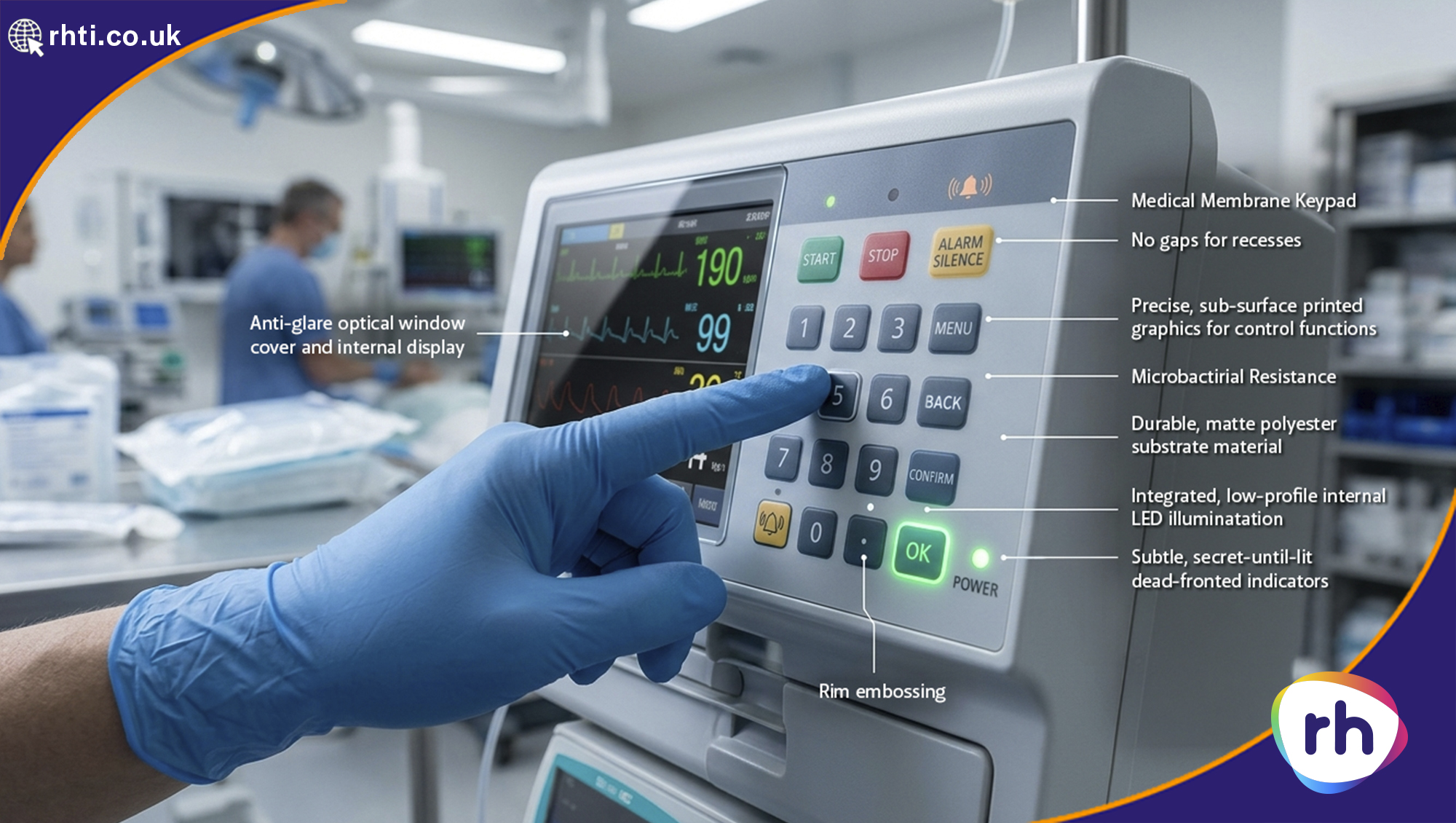
Bespoke medical keypad solutions resolve this threat by providing a completely flat, seamless user surface. This flat design removes physical traps for dirt and fluids, allowing for immediate cleaning. However, material integrity is equally vital. Medical equipment is routinely disinfected with strong chemical agents, isopropyl alcohol, and bleach solutions. While standard polycarbonate substrates are common in consumer electronics, they can crack and yellow under constant chemical exposure. Therefore, we utilise high-performance, heat-stabilised polyester for medical graphic overlays due to its exceptional chemical resistance and mechanical life.
To enhance surface hygiene, we can incorporate advanced antimicrobial films into the top layer of the interface. Technologies such as MacDermid Microban or Autotex AM employ micro-agents that actively disrupt bacterial growth on surfaces. When paired with high-quality perimeter gaskets, the complete assembly achieves robust Ingress Protection ratings like IP67. This sealing keeps internal electronic circuits fully dry and secure during intensive spray-cleaning cycles.
- Seamless Face Architecture: Prevents fluid ingress and eliminates microscopic traps for biological matter.
- Polyester Material Selection: Resists chemical degradation from harsh hospital disinfectants and prevents structural cracking.
- Integrated Antimicrobial Technology: Incorporates specialised coatings that continuously inhibit bacterial reproduction on surfaces.
- High Ingress Protection Sealing: Ensures compliance with IP65 or IP67 standards, safeguarding internal switch circuits.
Tactile Feedback, Sub-Surface Printing, and Custom Embossing
In fast-paced medical environments, a user interface must communicate clearly with the operator. A clinician adjusting an infusion pump or managing a ventilator cannot always look directly at the keypad to confirm a command. They require instant physical feedback. Touchscreen systems lack this physical feedback, creating operational friction when users wear thick surgical gloves.
Custom membrane keypad embossing solves this issue by creating physical shapes that guide the operator’s fingers. We use precision-machined steel dies under exact heat and pressure to permanently form the polyester substrate. This forming does not stress the material or distort printed graphics. Depending on the device needs, designers can select from different embossing styles:
- Rim Embossing: Raises only the outer border of the key, helping a gloved finger centre itself on the switch naturally.
- Pillow Embossing: Raises the entire button surface into a flat-topped dome, creating a larger target area for quick operation.
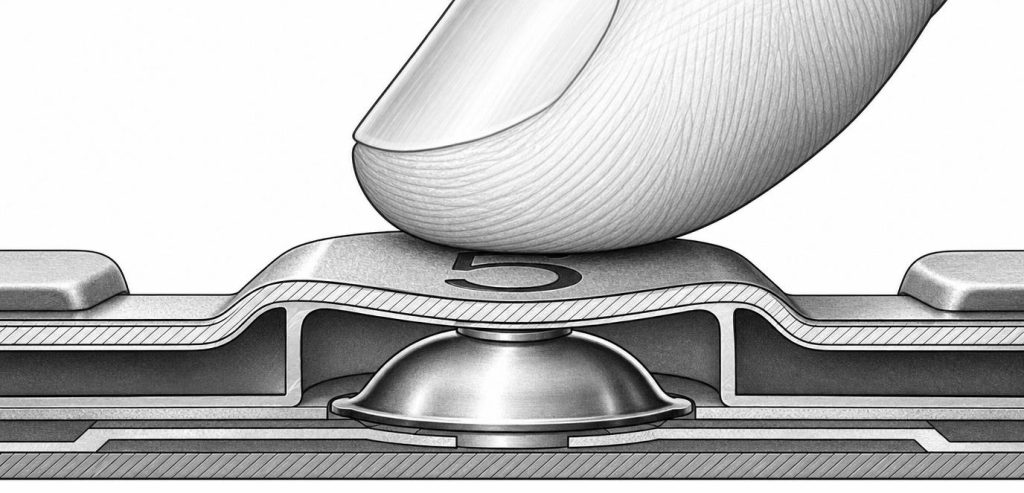
Beneath these embossed keys, we embed stainless steel or polyformed domes into the circuitry. When pressed, the dome flexes to provide a sharp, physical “click” that confirms activation through layers of latex gloves.
Protecting the keypad’s visual markings is another key engineering challenge. If instructional text or warning symbols rub off during cleaning, the device becomes unsafe. To prevent this wear, we utilise sub-surface screen and digital printing. We apply high-density inks to the underside of the transparent polyester layer. The outer plastic film shields the printed graphics from all physical friction and chemical exposure, keeping labels perfectly sharp for millions of cycles.
- Positive Tactile Response: Employs metal or poly domes to give clear physical confirmation through medical gloves.
- Precision Tooled Embossing: Offers custom rim or pillow profiles to guide user hand placement without visual focus.
- Sub-Surface Print Protection: Places graphic inks behind the outer substrate to prevent wear from continuous abrasion.
- High-Density Operational Graphics: Delivers enduring visual clarity for critical safety warnings and system labelling.
Advanced Interface Illumination and Display Window Engineering
Medical environments feature widely varying lighting conditions. Control interfaces must remain legible in bright surgical suites, dark radiology rooms, and dimly lit hospital wards at night. Effective backlighting and clear display layouts are essential for reducing operator error and ensuring rapid response times.
Integrating ultra-thin, surface-mounted light-emitting diodes (LEDs) inside the layers of a membrane keypad provides excellent local lighting without adding mechanical bulk. For complex panels that require completely uniform light across text zones, Light Guide Film (LGF) is an exceptional solution. LGF uses a specialised, thin acrylic layer to distribute light from edge-lit LEDs evenly across the keypad surface. This method removes hot spots and lowers overall power draw.
To improve the user experience on complex control panels, engineers can apply a technical graphic technique known as “dead-fronting” or “secret-until-lit” graphics. This method ensures that specific warning indicators or symbols remain hidden from view until their background LED illuminates. This keeps the interface clean and prevents operator confusion by displaying information only when active input is required.
Furthermore, medical keypad solutions often feature clear optical windows that cover internal LCD or OLED display screens. High-intensity clinic lighting often causes strong reflections on flat plastic. We counter this issue by applying specialised anti-glare, matte finishes over the display windows. This treatment diffuses reflections while keeping high clarity, allowing staff to read vital signs accurately from wide viewing angles.
- Low-Profile LED Integration: Places thin-film light sources directly into the switch matrix to preserve slim device profiles.
- Light Guide Film (LGF) Uniformity: Ensures smooth, balanced illumination across large graphic fields and button groupings.
- Dead-Front Warning Graphics: Conceals background indicators until activated, clarifying the user workspace during emergencies.
- Anti-Glare Optical Windows: Minimises ambient light reflections to keep internal screens readable from all operating positions.
Electromagnetic Shielding, High-Bond Adhesives, and Supply Chain Traceability
Modern medical facilities contain a dense array of electronic equipment that emits invisible electromagnetic energy. Systems such as MRI scanners, surgical tools, and telemetry hardware generate significant Electromagnetic Interference (EMI) and Radio Frequency Interference (RFI). Without proper shielding, this electronic noise can cause nearby medical instruments to malfunction, resulting in false alarms or power disruptions.
To protect critical systems from these unseen currents, we integrate a dedicated shielding layer directly into the membrane keypad structure. By printing a micro-fine conductive silver grid or laminating a thin aluminium foil layer within the switch assembly, we build a dependable Faraday cage. This internal shield routes stray signals safely to the device ground, blocking external interference and stopping the keypad from broadcasting its own electronic noise.
Long-term survival also depends on the physical bond between the interface and the device housing. Cleaning fluids can seep behind loose edges, attacking adhesives and causing layers to peel apart. We prevent this by utilising high-performance, engineering-grade acrylic adhesives from leading manufacturers like 3M. We select these materials for their ability to bond tightly to low-surface-energy plastics and cast metals, maintaining a permanent seal over decades of operational service.
Finally, compliance and verification are non-negotiable within the healthcare sector. At RH Technical Industries, our production environment fully satisfies international environmental regulations, including RoHS mandates. We recognise that the medical supply chain demands complete data tracking. Our internal enterprise resource planning (ERP) system tracks every material batch and manufacturing step, providing complete traceability from raw plastic substrates to the final tested component.
- Comprehensive EMI/RFI Insulation: Implements conductive grids or foils to isolate internal electronics from environmental electromagnetic interference (EMI) and radio-frequency interference (RFI).
- High-Performance Adhesive Selection: Utilises industrial 3M bonding systems to eliminate edge delamination and moisture migration.
- Full Regulatory Compliance: Builds products using materials that meet RoHS standards for hazardous substance restriction.
- Complete Batch Traceability: Tracks all raw substrates and components via an integrated ERP network to simplify regulatory audits.
Medical Keypad Solutions – Conclusion
Designing and manufacturing high-performance medical hardware demands attention to detail and a commitment to quality. There is no allowance for error when patient outcomes are on the line. Every layer of the human-machine interface must be engineered to withstand the unique challenges of the clinical workplace.
At RH Technical Industries, we bring decades of specialised print capability and material expertise to the medical device market. By combining tough polyester substrates, precise embossing, sub-surface graphics, and robust electromagnetic shielding, we create custom user interfaces that electronic OEMs can deploy with confidence. Our team offers full engineering support from initial concept through production to ensure your product delivers absolute reliability. To evaluate our materials or discuss your specific design requirements, visit rhti.co.uk today.